Tuesday, 29 March 2016

Old Steps but New Attitudes


For some reason body language and appropriate touching has been on my mind lately.  I do a fair amount of dancing and one partner of mine I hadn't seen in months.  I know there was illness in his family and that my friend and taken temporary leave from work to travel and help get his family during the health crisis.  So, his return to dance classes was a welcome sight and I literally skipped to where he was standing.  Unselfconsciously, he throws his arms around me.  But all of sudden it was as if an electronic current ran through him and he backs away in haste.  Next, he starts apologizing.  I am standing there looking confused.  These were his words, " I am so sorry but I've just gotten back from Cape Breton."  Then he lets out a sign of relief "oh that's right, it's OK you're from Quebec."

Notice how our mutual cultural background dictated what was appropriate.  When I first moved away from Montreal and started graduate school in Toronto it was not uncommon for someone to remark, "You're not from here, are you?"  When I asked people how they could tell I got a variety of answers.  One is the characteristic way I have of using my hands when I talk.  I was an Anglophone but I gestured like a Latin.  Also, you could stand much closer to me before I flinched so people assumed that I had a French or Italian background.  Then there is eye contact.


I think this has become more acute with time and our shifting gender roles.  A few weeks back I was taking a dance workshop.  Whenever the older men had a question it was inevitably about getting the steps right.  When the younger men spoke up it was about their feelings and concerns.  How close am I allowed to hold my partner?  How do I know what she is comfortable with?  I've also found it revealing that gender has dropped out a lot of the references or teacher's guideline for etiquette.  You now approach someone and say, "Are you a lead or a follow?"

Sunday, 13 March 2016

Silent Auctions to Become More Ethical

One Saturday,  I was at the home of Gary Kachanoski (President of MUN) and his partner Teresa (chair of Visual Arts NL).  The occasion was a fundraising silent auction to benefit the Excellence in Visual Arts Awards.  Silent auctions are the mainstay in fundraising whether the cause be ecological (Ducks Unlimited), social justice (like the many around the refugee families), or artistic –like Teresa Kachanoski's.  Generally, collectors come out to enjoy the party atmosphere, a little friendly competitive bidding and hopefully, to snag a bargain.  Unfortunately, there are often two losers in this game: the commercial art galleries and those at the very bottom of the food chain, the artist.  

The first effort to address this situation has been the "minimum bid".  Basically, an artwork is NOT allowed to go for less than the stated price–but that still left the commercial art galleries out.  That Saturday, was the first time I heard the announcement, "if you were not able to get the piece you wanted.  We hope you will go to the gallery that represents that artist for another piece."  VANL is trying to create a win-win-win protocol with a percentage going to the gallery as well.  This is part of a national trend but one I think is crucial in smaller cities like St. John's where there are fewer players in the game.


Here is Teresa's piece for the Broadside, VANL's online publication, on the topic:

“There is more to representing art than selling art. The life of the gallery is dependent on the renewal and refreshment of its artists and dealers. When that stops happening, it’s the end.” - Arne Glimcher

In Newfoundland and Labrador, You Can Die of Exposure

by Teresa Kachanoski, Chair of the Board
Everyone loves getting a good deal at an art auction, especially if the proceeds go to help a beloved charity. You go home with a lovely piece of artwork and you feel good about being generous.
There is another side to this story that doesn’t get the attention it deserves. Artists and art dealers are too frequently asked to donate work to charity auctions and the practice has become detrimental to local galleries and to the visual arts sector in general. The justification of “getting exposure” by donating work has been found untrue. Gallery owners see a dramatic drop in sales during months when art auctions abound, while artists are not getting paid for their work. As art auctions are equally popular and problematic, we are currently in the process of developing a series of recommendations and guidelines to make charities aware of the issues.

VANL-CARFAC is also in a situation where it needs to raise funds. For the past 11 years we have put on the Excellence in Arts (EVA) awards, with proceeds entirely generated by private sponsors and through fundraising efforts. This year we will indeed be having a fundraising event that will feature an art auction, but our auction will be different and we will make sure our guests are aware of the issues.

The artwork we will auction has been provided by local galleries, but we will set the minimum bid at the gallery price. The galleries will receive their commission, the artists will receive their share, and VANL will get the surplus amount above the minimum. While we will not receive a large return on each piece, we do feel that it’s a win-win-win situation that will help open a dialogue about best practices in these situations.

Galleries are an essential part of the art-making world. They provide artists with marketing, promotion, advice, expertise, support and feedback. The work they do by educating and alerting the public to trends, establishing fair prices, and providing a context in which artists can sell their work even benefits those artists who are not represented by galleries . By supporting these integral parts of the visual arts community, we are ensuring both the galleries, and the visual arts as a whole, remain able to fulfill their role in maintaining the vibrant culture of Newfoundland and Labrador.

Monday, 7 March 2016

Comic collision or comic calamity?

This past week I published a review of Boeing, Boeing with the Telegram.  The original play in French by Marc Camoletti was written in the sixties.  It is a farce that has been adapted for screen several times, for example the Hollywood version featured Jerry Lewis and Tony Curtis and it has even been done three times for Bollywood in India.  It is a classic battle of the sexes plot and I was wondering how it would play to a post-feminist audience.  What I probably should have been more concerned about is the customary cross-dressing shtick and how that would wash with our transgendered times.  Turns out the audience didn't share my concerns–or at least I couldn't tell if they did.


Boeing Boeing
Joint Productions
Barbara Barrett Theatre, March 3-5, 2016

The opening Paris apartment scene of Boeing Boeing, sparks the interest of the audience with the vividly drawn characters of the king-of-smug, bachelor Bernard, his honey pot, fiancĂ© Gloria, and the long-suffering, stoic maid Berthe.  In quick succession, we are introduced to the other two "high flying" fiancĂ©s–all three are airline stewardesses or Bernard's very own international harem.  Mix in the arrival of the periwinkle-eyed Robert from Wisconsin and you have a guaranteed comic collision.

Bernard explains to Robert that he keeps his conjugal life in perpetual motion with the help of an international airline schedule.  You keep one ascending, one descending and one in flight.  The audience knows from the get-go that this is a simple plan ripe for disaster and waits with bated breath to watch Bernard's love life go down in flames.  Boeing Boeing premiered in 1960 as a thigh slapping farce and the appeal of watching a cad get his comeuppance has not diminished.

Joint Productions' version starts out on a relatively mellow romantic note and smoothly but quickly gains speed and volume.  In short time, the cast members are striking melodramatic poses, dripping memorable accents and slamming doors with hyperbolic threats.  The beauty of it is that it is all self-evident and the audience is seduced into that suspension of disbelief.  By the time intermission rolls around, the plot is teetering on the edge of its crescendo. In anticipation, audience members are taking bets on which one of the lovelies will snag their catch.  Will it be the willful American Gloria (Lynn Panting) with her Marilyn Monroe pout, the Germanic Gretchen (Hillary Bushell) with the powerful passion worthy of Wagnerian opera or the sultry Italian Gabriella (Alanah Whiteway) with the Sophia Loren strut?  Or will they ultimately combine forces and engage the men in a battle of the sexes?  The second act and the play's conclusion provide a satisfying but unexpected ending.

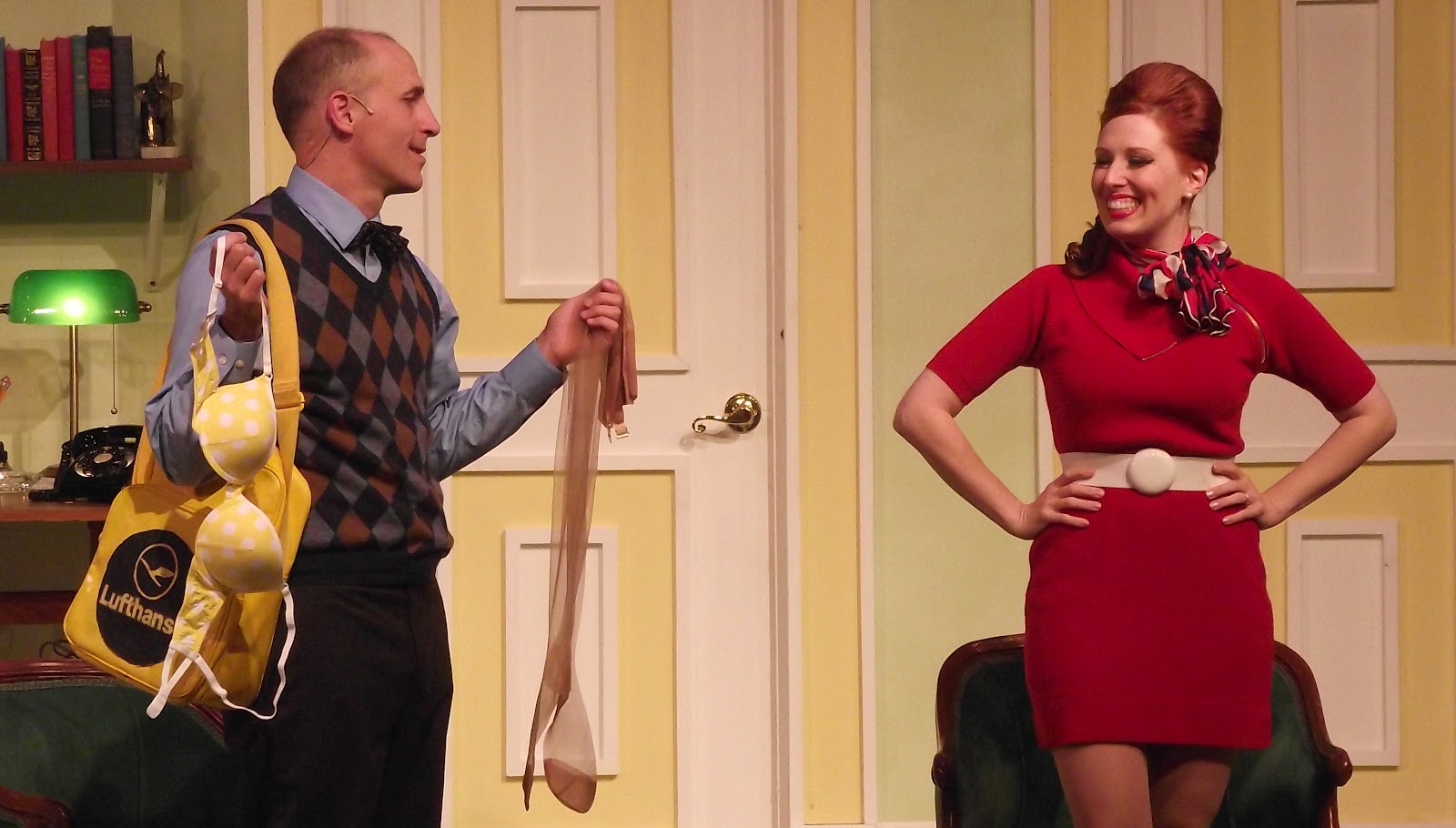
This image comes from a U.S. production (not by Joint)
 that shows the infamous man with "his lingerie" scene.

Bernard (Glenn Gaulton) and Robert (Phil Goodridge) make the perfect odd couple.  Both actors have played these characters in Marc Camoletti's companion farce Don't Dress for Dinner and that no doubt informs their chemistry on stage.  It would be too simple to describe them as a study in opposites although their physical differences are clear assets.  They trade emotional places effortlessly pivoting from calm to calamity.  Berthe (Janet O'Reilly) too orbits her own emotional range from sanguine to sarcastic and back again.


Ultimately, Boeing Boeing is an ensemble acting effort that works, especially in the risk taking second act when the slapstick action and one-liners reach near hysteria.  Director Ian Campbell is to be credited with an attention to detail that ranges from the mood music that greets you when you enter the theatre to ensuring that every member of Joint Productions is regarded as a collaborator.

Sunday, 28 February 2016

Without Sentimentality or Sensationalism


If a Place Could Be Made
Louise Moyes, Diane Daly, and director Anne Troake
Resource Center for the Arts
February 25 - 27, 2016


Louise Moyes and Diana Daly with Ryan's Fancy in the background.
If a Place Could Be Made tells the true story of Kitty and Daniel Daly of Riverhead, St. Mary’s Bay and their sprawling family of twelve children born between the years of 1913 and 1934.  The storyline has the makings of a Newfoundland fable– for six of the children were very tall and six had achondroplasia, or dwarfism.

The Daly family's stories are told through the talents of great-granddaughter (and great-niece) songwriter Diana Daly, dancer-actor Louise Moyes, and director Anne Troake.  When Kitty Daly gave birth to two small children after the birth of one able bodied child she went not to a doctor but to the archbishop to see what she could do.  The archbishop offers her absolution so that she wouldn't have to have more children.  Instead, the husband and wife decline.   The Daly family's decision to continue to grow their family is a story of inclusion regardless of difference and their faithful commitment is the meaning that lies behind the play's title.  If a Place Could Be Made puts our contemporary, politically correct era to shame and shows us what meaningful inclusion really looks like.

The drama relies heavily on projected images of the actual family to evoke their presence.  While the stage is full of emotion and nostalgia it is actually a relatively sparse production.  Action is largely focused on the home life of the family:  the stream of visitors, card games and songs.  There is an air of privacy, of an internal life and the audience is given not a sense of the extraordinary but of the ordinary.  We get an impression that the children were protected and within that emotional shelter they grew up with a healthy sense of self-esteem.  The events of the play are based on the memories of Diane Daly's grandfather, who was the eldest of the twelve children.

There is something decidedly understated about If a Place Could Be Made.  It is a drama that is presented without cloying sentimentality or visual sensationalism.  It is at the other end of the spectrum when compared with dramas about, for example, the Dionne Quintuplets.  We are not made to feel regret over the fact that none of the six children who were born with dwarfism never married.  Moyes and Daly portray the characters as being proud people who wouldn't want our pity and all their artistic decisions–script, gesture, and staging– support that impression.  If a Place Could Be Made doesn't end on a triumphant air.  It is a story about acceptance and getting on with life.


Sunday, 21 February 2016

Ms. Words for Fun and Profit

I was standing on the sidewalk in the cold talking shop with a Mexican journalist this week in St. John's.  At one point in the conversation I indicated quotation marks by curling my fingers in the air.  He grinned and I said, "Ah you like my mitten marks".   And then in unison we added "just couldn't resist the alliteration".  We burst into laughter.

We had been talking about one of my writing assignments – a review of a concert that I was very much looking forward to by Duo Concertante.  Today that review runs in the on-line version of The Telegram newspaper and will be in print tomorrow.  As always, the assignment turned out differently than I expected.


We'll Get Bach To You
Duo Concertante
D.F. Cook Recital Hall, Friday, 19 February 2016


The celebratory nature of the concert We'll Get Back To You, which launched the 2 CD set of Bach sonatas by Duo Concertante on Friday night, was muted by the sad news of the death of composer Cliff Crawley.  As a result both mood and programme were altered reflecting the deep impact of Crawley's involvement with the careers of Nancy Dahn and Tim Steeves, who are the halves of Duo Concertante.  Over years and more than thirty compositions ranging from show tunes to classical, Crawley had crafted music that highlighted the trademark of Duo Concertante, where the piano and violin equally support each other. 

Crawley was more than a composer, he was a collaborator and in fact when It Takes Two was launched in 2009 Nancy Dahn remarked to me that the CD could have been titled It Takes Three.  When I asked Cliff about what it was like to compose for the Duo he responded, "It's wonderful, they can do anything I ask!"  So, it was a bittersweet echo to hear Tim Steeves remark from the stage that, "Cliff Crawley could do anything –taking music from various genres…and always making it sound like his own."  In particular, when the last notes of Crawley's arrangement of the traditional folk song The Lark evaporated the silence was moving.
Nancy Dahn (violin) and Tim Steeves (piano) are the
 two halves of Duo Concertante.

Still, somber was vanquished with sabers – Khachaturian's flashy Sabre Dance, which meant the programme went into intermission with high spirits.  Similarly, the evening concluded with the virtuosic Sonate composed by Ravel.  The concert was still true to its name by presenting two full, luscious Bach sonatas: The Sonata in A major, BWV 1015 and the Sonata in E major, BWV 1016.

Duo Concertante's new release offers six J.S. Bach sonatas, some of which are rarely performed.  The selection of sonatas demonstrate the wide scope of Bach's creative genius and the appeal of his music– from organic, beautiful melodies to intellectual and rigorously structured pieces that sparkle with ornamentation.

J.S. Bach (1685-1750) composed during the Baroque musical era and it has been popular in the past few decades to play his music on Baroque instruments in a bid towards authenticity.  Tafelmusik, based in Toronto, is widely known for that distinctive warm sound that period instruments and bows strung with gut produce.  Duo Concertante has bucked that trend and chosen to interpret Bach on contemporary violin and keyboard but in a way that is historically informed.  The consequence is that even those of us who are neither musicians nor musical scholars can come away with an enhanced experience of Bach's musical language–for instance, to me, that the harmonies may be sweet but are never sentimental.

The liner notes of the CD are done in a refreshing interview style rather than an arid erudite exercise.  Paul Rice asks the right questions and unlocks the insights of Tim Steeves and Nancy Dahn.  He asks them, for example, to contrast the making of their Beethoven CD with this Bach undertaking.  With such efforts, combined with memorable performances, Duo Concertante is building a bridge of accessibility for a wider audience of classical music.

Gloria Hickey


DUO CONCERTANTE SET TO RELEASE NEW CD
JS BACH: SIX SONATAS FOR VIOLIN AND KEYBOARD
MARCH 18, 2016 on MARQUIS CLASSICS


Sunday, 14 February 2016

Taking Valentine's back from Hallmark

View from the interior of Afterwords bookstore on a snowy afternoon.

After our first date, when I find out she has a boyfriend (or, as she explains, an ex-boyfriend who is not yet completely out of the picture), I sign off gallantly in an e-mail, “I am at your disposal.”

Except what I’ve written is “I am your disposal.”

There, that was my obligatory nod to Valentine's Day.  And for the record that was a quote from a memoir titled, The Diaries of Pussy-Cake by Gary Shteyngart.  This year I was determined not to let Valentine's Day devolve into a dutiful Hallmark moment.  There have just been too many near misses in my life lately to not be more mindful. 

I'll give you two examples.  Like a lot of other pedestrians in the City of St. John's I recently made a rather dramatic face-plant on the icy sidewalks.  One of my friends has been laid up for weeks with a leg broken in three places.  Luckily for me as I lay on my face, groceries askew wondering what was the safest way to try and get up, I feel a pair of strong arms pick me up.  A kind stranger drove me home, which almost sounds like a Hallmark Valentine card–this second example won't.  I was walking home across downtown when I encountered a tight knot of emergency vehicles and crime scene tape.  Apparently, a drunk driver had lost control, took down a power pole and struck two pedestrians.

Despite the snowstorm, TBS raised $8,055.70.

So, I decided to sidestep the customary this year and make a determined effort to give in meaningful ways this Valentine's.  My community made it easy.  On Saturday the 13th, I went down to my favourite tattoo establishment, Trouble Bound Studio, where boss man Dave Munro and his crew of talented artists annually donate their time around Valentine's in order to raise money for Daffodil Place, which supports families undergoing cancer treatment.  I made a cash donation and as soon as my glasses had unfogged and I collected a hug I was on to my next destination.

At Gower Street United Church there was a fundraiser in full swing to benefit a Syrian refugee family.  The Atlantic String Quartet was on stage playing a tango ripe with attitude, silent auction tables dripped with certificates for services and goods, raffle tickets were being snapped up with the prize catch being a pair of West Jet tickets for anywhere the airline flew.  Friends too organized this event.  I caught Flower Hill's soulful set, felt good about leaving a donation and limiting myself to only one very large cookie.  Then a whopper of a snowstorm rolled into town and I trudged home.


The snow was blinding but I still could make out the bundled shape of Andy Jones, whom I congratulated on his performance as Habib, which I caught during a matinee last week.   I decided on Sunday to help my neighbours dig-out and received more hugs. While thigh-high in snow I learned from Amy House that the Saturday snow forced the LSPU Hall to cancel a sold-out performance.  Mother Nature willing audiences will be lucky tonight.

Tuesday, 9 February 2016

SISTER ACT is about Bonding Beyond Gender

I try and follow the practice of doing something everyday that you have never done before.  Other self-help groups have versions of this: do something that scares you. etc.


Well, well the universe always seems to be sitting on my doorstep ready to deliver and this past several days it was:   review a musical.   I hate musicals.   But my axiom as a  critic is set aside your beliefs and open up your mind

I had my mind blown when I answered the request of the Telegram to review Sisters Act.   I could have picked it apart but that would have been personal.  And a reviewer should not be.

Et Voila  this is what the paper printed:
Sister Act
February 4 to 7th, 2016 - shows added
St. John's Arts & Culture Centre


What a better way to start a review of Sisters Act than with a true confession?  I cried.   I never expected that a story about a gangster and his lounge-singing girlfriend would make me cry.  And in the plot preamble they tell you about the murder she witnessed and how she would hide in a convent.  But no, you don't hide Delores the lounge singer anywhere– even if you take away her sequins and microphone and dress her as if she was among a flock of penguins.  And they were a dysfunctional choir of nuns at that.  However, Delores' infectious energy, tell-it-like-it is wisecracks and savvy dance moves will transform them.

Dana Parsons, who plays Delores, leaves it all on stage, every time she is there:  heart, soul and every vocal chord.  And that is also true of the 30-some odd cast members and the dance ensemble.  There was such an outpouring of energy and emotion on stage that the audience could not help but respond.  The directors Jacinta Mackey Graham and Douglas Vaughan are to be commended for crafting an experience that swept male and female, old and young away for two hours plus in the audience.  Even when the visuals of the staging could not keep up with the rollicking good humour - no one cared.  And if you have a sold out audience having that much good fun no one is going to remember that the lighting was not perfect.

I wasn't expecting that a musical about a central character in witness protection would be a play about bonding, sharing and human love.  Sisters Act was a drama that was a lot more than about "girl power" or standing up to the controlling man in your life.  After all, Delores just trades in surly Curtis for sweaty Eddy at the end or at least that's what the chorus of swooning nuns and Eddy's strut suggests.  What was intriguing was how convincing was the transformation of Delores from puppet girlfriend to convent catalyst and how she impacted the nuns' lives . 

Now in true over the top musical stage tradition there has to be a bunch of things that happen all at the end in a grand– a sort of fanfare, dramatic display or grand finale.  And Sister Act did not disappoint.   The Pope showed up, the somewhat sinister bill collecting men in suits decide to finance the church instead of buying it and well you get the general idea.  The girl gets the guy, the day is saved and…isn't this why musicals do so well in times of social and financial depression?  The dirty thirties, those big productions with tuxedos and tap dancing down grand staircases…We needed them then and we need them now.

Gloria Hickey